
$190,100+ Earners: Protect Your FWC Claim With This Evidence Checklist
Earning above the high income threshold does not automatically block your unfair dismissal claim. For dismissals from 1 July 2026, that threshold sits at $190,100. If a modern award or enterprise agreement covers your job, you can still apply regardless of salary. You also need to clear the minimum employment period and lodge within 21 days.
TL;DR:
- Earning above $190,100 from July 2026 does not automatically exclude you from unfair dismissal claims if your role is covered by an award or enterprise agreement.
- Coverage depends on work classification and contractual details, not just salary, so high earners can still qualify if their duties align with award classifications.
- Only guaranteed salary, allowances, fixed non-monetary benefits, and extra super contributions count toward the threshold; bonuses, reimbursements, and discretionary benefits do not.
- You must lodge your unfair dismissal claim within 21 days of your dismissal, and initial evidence collection should start immediately to avoid missing deadlines.
- Disputes about high income thresholds are resolved early, often based on documented benefits or classifications, so maintaining clear records from the start is crucial.
Table of Contents
- What is the high income threshold for unfair dismissal?
- Can you still claim if you're covered by an award or agreement?
- How do you calculate earnings for the threshold?
- What other eligibility tests apply besides income?
- When do you need to lodge your unfair dismissal claim?
- What can you actually win if your claim succeeds?
- What do real threshold disputes actually look like?
- What should you do right now to protect your claim?
- What the threshold debate misses
- Where to check the official rules yourself
- Sources
- FAQ
What is the high income threshold for unfair dismissal?
The high income threshold exists to draw a line between employees whom the Fair Work Act protects automatically and those who need award or agreement coverage to get the same access. It's one of three eligibility filters in the unfair dismissal jurisdiction, alongside minimum employment period and national system coverage, and it trips up more high earners than most people expect.
For dismissals taking effect from 1 July 2026 to 30 June 2027, the figure is $190,100. That's up from $183,100, which applied to dismissals between 1 July 2025 and 30 June 2026, according to the Fair Work Commission. The number that matters is whichever threshold applied on the date your dismissal took effect, not the date you lodge your application or the figure current when you started the job. A pay rise or indexation after you were let go changes nothing about which threshold applies to your case.
Here's how the threshold has moved in recent years:
| Dismissal period | High income threshold |
|---|---|
| — | $183,100 |
| 1 July 2025 to 30 June 2026 | $183,100 |
| 1 July 2026 to 30 June 2027 | $190,100 |
The trend is upward every year, tracking wage growth broadly. If your salary sits close to the line, check the exact figure for your dismissal date before assuming you're excluded.
Can you still claim if you're covered by an award or agreement?
Yes. Section 382 of the Fair Work Act says you're protected from unfair dismissal if you either earn under the threshold or you're covered by a modern award or enterprise agreement, whichever gets you there first. Salary alone doesn't decide the outcome. A lot of people assume a six-figure package rules them out, then discover their role sits under an award they'd never thought to check.
Coverage usually comes down to the nature of the work, not the job title or pay grade. A senior operations manager on $210,000 might still be covered by a clerical or logistics award if their duties fit its classification structure. Enterprise agreements work the same way. If your employer negotiated a workplace agreement that names your classification, that coverage can survive even a high salary.
Practical ways to check:
- Search the Fair Work Ombudsman's Find My Award tool using your job duties, not your title.
- Check the Fair Work Commission's enterprise agreements register for any agreement your employer has made.
- Review your employment contract for a written guarantee of annual earnings, which can exclude award coverage even where duties would otherwise fit.
- Ask whether your employer classified your role under an award for other purposes, such as overtime or allowances, since that's often a strong sign of coverage.
Common fact patterns that preserve access include tradespeople and technical staff earning well above the threshold but still classified under an industry award, and mid-level managers whose position description matches an award classification despite a senior-sounding title.
How do you calculate earnings for the threshold?
Getting this wrong is one of the most common reasons people wrongly assume they're excluded. The Fair Work Commission's guidance sets out what counts as earnings and what doesn't, and the gap between "salary package" and "earnings" for threshold purposes can be significant.
Included in earnings:
- Your guaranteed base salary or wages.
- Guaranteed allowances that form part of your ongoing pay, not one off payments.
- The agreed money value of non monetary benefits, such as a car or phone, where that value is fixed in your contract.
- Superannuation contributions above the compulsory minimum, if your employer pays extra on top of the statutory rate.
Excluded from earnings:
- Reimbursements for expenses you've actually incurred, like travel or tools.
- Bonuses or commissions that aren't guaranteed, even if you receive them most years.
- Compulsory superannuation guarantee contributions, which never count toward the threshold no matter how large your package looks on paper.
Vehicles, accommodation and other private benefits need careful valuation, and Regulation 3.05 of the Fair Work Regulations sets out the method for calculating these amounts, including how piece rates and non monetary benefits are treated. The Commission can estimate a notional value for a benefit if your contract doesn't specify one, which is exactly where disputes tend to erupt.
Pro Tip: Keep your employment contract, remuneration schedule and any written benefit agreements together from day one. If your employer later argues a car or bonus should count toward your earnings, the paperwork that actually specifies the value (or shows it was never guaranteed) is what decides the argument.
What other eligibility tests apply besides income?
The threshold is only one of several tests you need to pass. Even a modest salary won't save a claim that fails on these other grounds.
- Minimum employment period: six months of continuous service if your employer has 15 or more employees, or twelve months if it's a small business under that headcount.
- National system employee: most private sector employees across Australia are covered, but some state government and specific state-regulated employment arrangements sit outside the federal system.
- Employee type: casuals need to show a regular and systematic pattern of work with a reasonable expectation of continuing employment, while genuine independent contractors generally fall outside unfair dismissal altogether, though some may have separate routes through regulated worker protections introduced for the gig economy.
These tests interact. A casual worker on $195,000 who clears award coverage still needs to show regular and systematic employment to get past the employee type gate. Check every box, not just the one you've heard about.
When do you need to lodge your unfair dismissal claim?
You have 21 days from the date your dismissal took effect to lodge Form F2 with the Fair Work Commission, and the Commission is explicit that you should lodge on time even if you're still gathering documents.
- Lodge Form F2 within 21 days, even with an incomplete application. Missing payslips or contract copies can follow later; a missed deadline generally can't.
- Pay the application fee, which the Commission increases annually for the 2026–27 period. A fee waiver is available where paying it would cause serious financial hardship.
- Apply for an extension only if you've missed the deadline, and expect a high bar. The Commission grants late applications only in exceptional circumstances, weighing the reason for delay, when you became aware of the dismissal, and any prejudice to your employer.
Don't wait until you've built a perfect case. A thin application lodged on day 20 beats a polished one lodged on day 22.
What can you actually win if your claim succeeds?
Reinstatement to your old job is the Commission's primary remedy, though in practice it's ordered less often than compensation, largely because trust between employer and employee has usually broken down by the time a matter is decided. Compensation is discretionary, not automatic, and the Commission weighs factors including your efforts to find new work.
For dismissals taking effect on or after 1 July 2026, the maximum compensation cap is $95,050, calculated as the lesser of your 26 weeks' remuneration or half the high income threshold that applied immediately before your dismissal.
That "lesser of" test matters. A high earner on $300,000 doesn't get 26 weeks of that salary; they're capped at half the threshold. Actual awards tend to land well under the cap once the Commission deducts income you've earned since the dismissal and factors in how much of the loss was genuinely caused by the termination rather than other circumstances.
- Compensation is never awarded for hurt feelings or humiliation, only for economic loss.
- Mitigation matters: failing to look for comparable work can reduce what you're awarded.
What do real threshold disputes actually look like?
Threshold objections are usually resolved as a preliminary question, before the Commission even considers whether the dismissal was fair. If your employer successfully argues you're above the threshold and not award covered, the matter ends there.
A 2023 Fair Work Commission decision illustrates how these disputes play out. Private use of a company vehicle, once valued and added to base salary, pushed the employee's earnings over the threshold and defeated an otherwise plausible claim. The lesson isn't subtle: benefits you might dismiss as perks can decide your case.
- Vehicle logs, benefit agreements and contract clauses specifying dollar values carried the most weight in these decisions.
- Verbal understandings about non monetary benefits rarely survive scrutiny without documentation.
- Employers who kept clear written records of what was guaranteed versus discretionary generally succeeded on threshold objections.
What should you do right now to protect your claim?
Lodge first, gather evidence second. That order trips people up constantly, because the instinct when you've just been dismissed is to build the perfect file before doing anything official. Don't. The 21 day clock doesn't pause for paperwork, and the Commission genuinely does accept applications with documents to follow.
Start assembling this while your application is pending:
- Employment contract and any remuneration schedule or letter of offer.
- Recent payslips covering the 12 months before dismissal.
- Superannuation records showing compulsory versus voluntary contributions.
- Any documents relating to a vehicle, phone, or accommodation benefit, including their agreed dollar value.
- Search results from Find My Award and any enterprise agreement that might cover your role.
- Copies of the termination letter, emails, or meeting notes from the dismissal itself.
Pro Tip: Preserve original emails with their metadata intact rather than screenshots, since dates and timestamps often matter more than the content itself. If you're sharing payslips with a third party, mask your tax file number before sending.
What the threshold debate misses
Most guidance on this topic treats the high income threshold like a hard wall: earn over it, and your claim dies. That framing is wrong often enough that it's actively costing people their rights. The award and agreement exception in section 382 isn't a rare technicality, it's a genuine second pathway that plenty of well paid employees never bother checking because nobody told them to look.
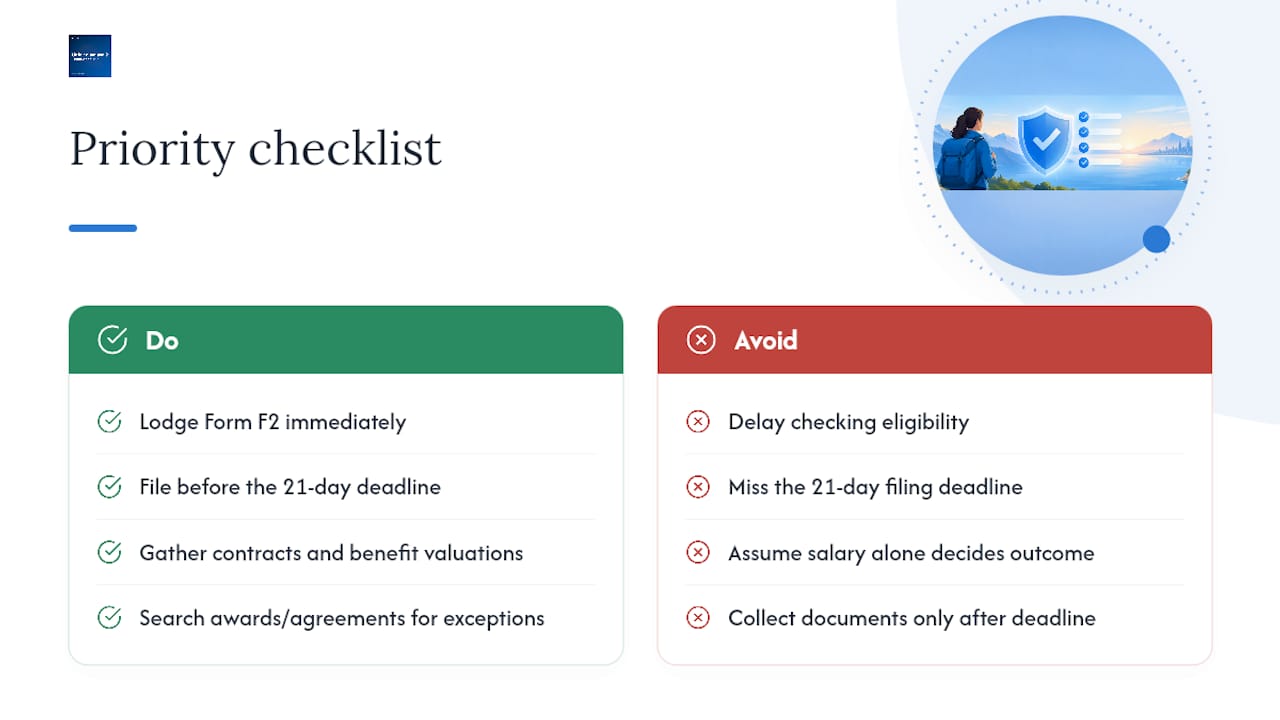
The conventional advice also underweights timing. People spend days deciding whether they're "even eligible" to claim, when the smarter move is to lodge Form F2 immediately and work out the threshold question afterward. A missed 21 day deadline is far harder to fix than a threshold objection is to argue.
If you take one thing from this, prioritise two things in this order: file on time, then build the earnings and coverage evidence properly. Salary alone rarely tells you the real answer, and the documents that decide these disputes (contracts, benefit valuations, award searches) are things most people don't think to collect until it's too late. Get organised early, and you're negotiating from a position of strength rather than scrambling under deadline pressure.
— Nicolas
Where to check the official rules yourself
For the current threshold, compensation cap and fees, go directly to the Fair Work Commission's high income threshold page and its deadlines guidance. For the underlying law, the Fair Work Act 2009 and Fair Work Regulations 2009 set out the technical detail, and the Fair Work Ombudsman's Find My Award and Pay and Conditions tools help confirm award coverage.
This article is general information, not a substitute for advice from a qualified lawyer. Consult a qualified legal professional about your own circumstances before acting on anything here.
Sources
- Increase to the application fee for 2026–27 | Fair Work Commission
- Fair Work Regulations 2009 - reg 3.05 (austlii)
FAQ
What is the high income threshold for unfair dismissal in 2026?
The high income threshold is $190,100 for dismissals taking effect from 1 July 2026 to 30 June 2027. Earning above this figure doesn't automatically disqualify you if a modern award or enterprise agreement covers your role.
What is the high income threshold for Fair Work in Australia generally?
It's the earnings cap the Fair Work Commission uses to decide whether an employee needs award or agreement coverage to access unfair dismissal protections. The figure rises each financial year, and the one that applies is whichever was current on your dismissal date.
How much compensation will I get for unfair dismissal in Australia?
Compensation is discretionary and based on your actual economic loss, not a fixed amount. For dismissals from 1 July 2026, the maximum cap is $95,050, calculated as the lesser of 26 weeks' remuneration or half the high income threshold.
Can high income employees get a guarantee of annual earnings under the Fair Work Act?
Yes, a written guarantee of annual earnings can exclude award coverage even where your duties would otherwise fit an award classification. Without one, award coverage often survives regardless of salary, which is why checking your contract and award status matters more than your pay figure alone.
Prepare your Fair Work Commission response with WorkForceHelp.
See how it works →General information about the Fair Work Commission process, not legal advice about your matter. WorkForceHelp is not the Fair Work Commission and is not affiliated with it.